




Pigot's Directory of Hampshire
Pigot's Directory of Hampshire, 1828, Southampton.
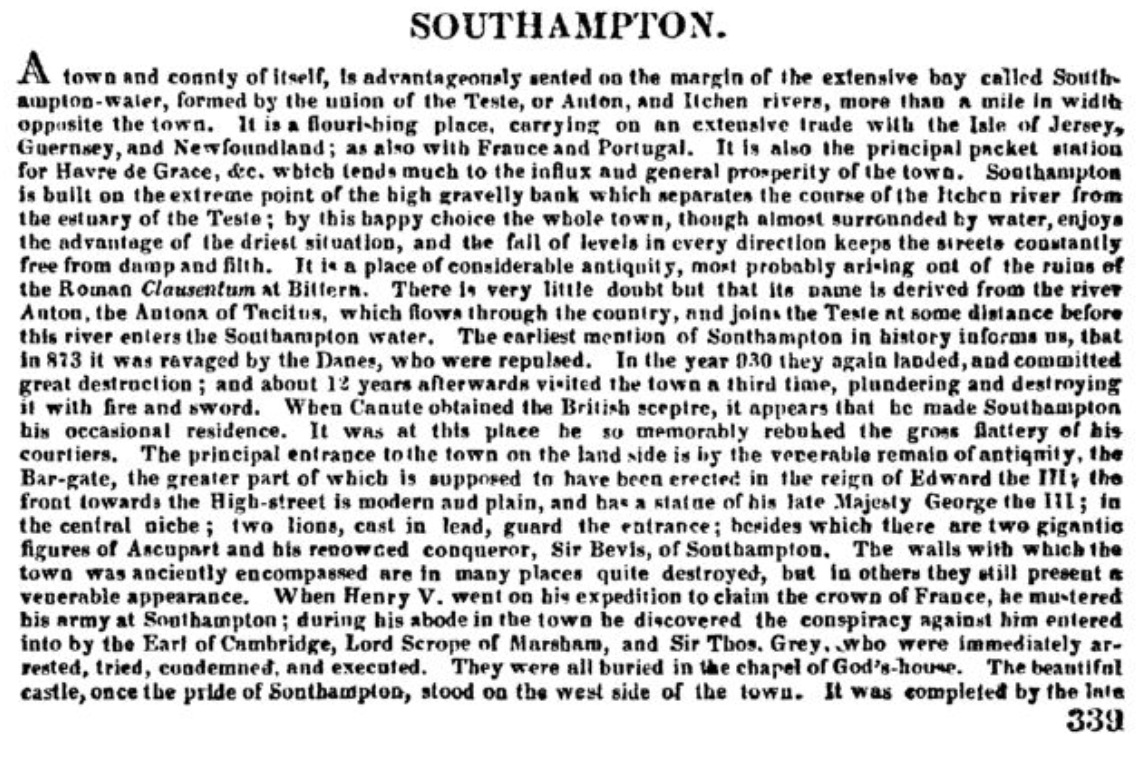
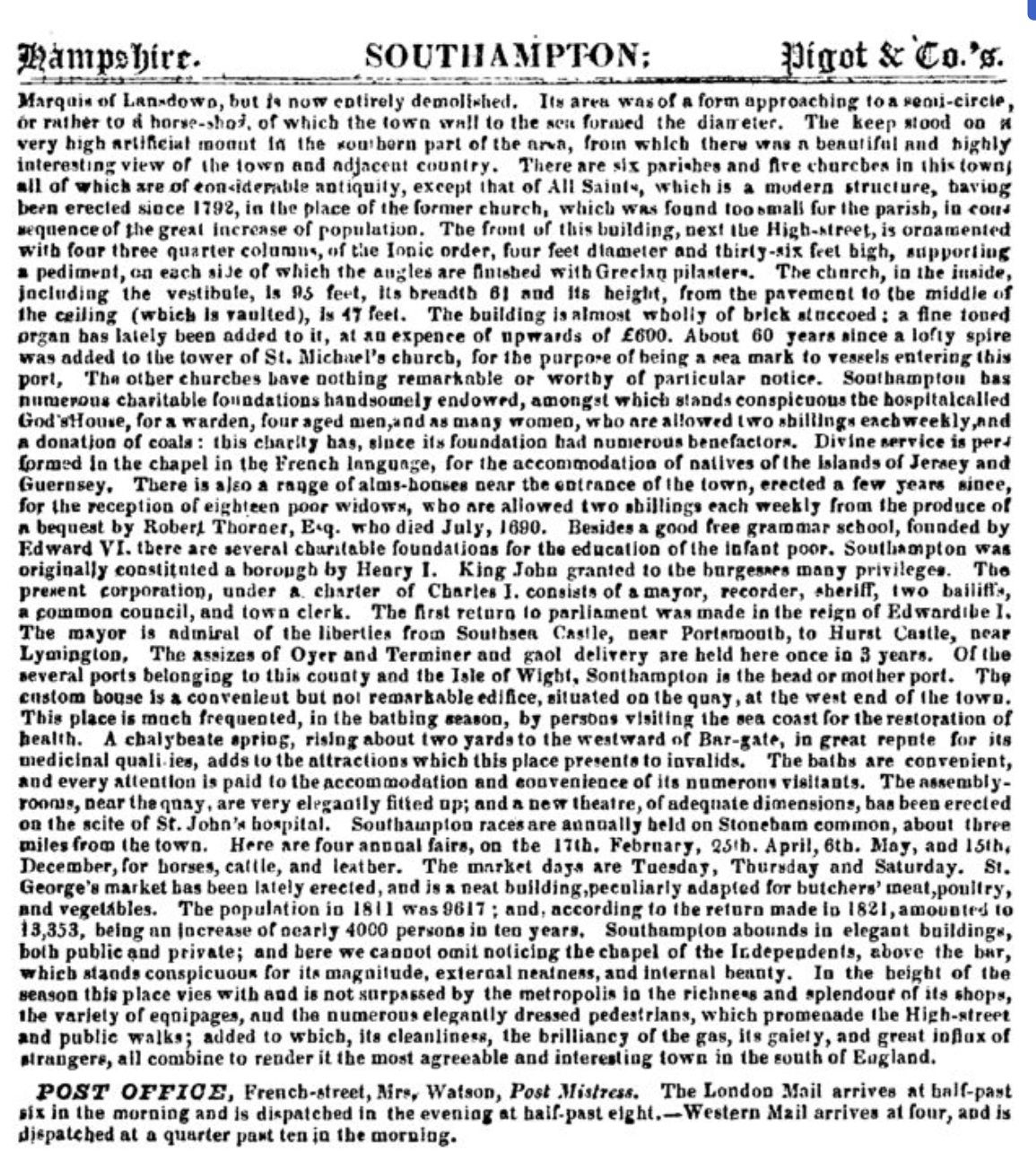
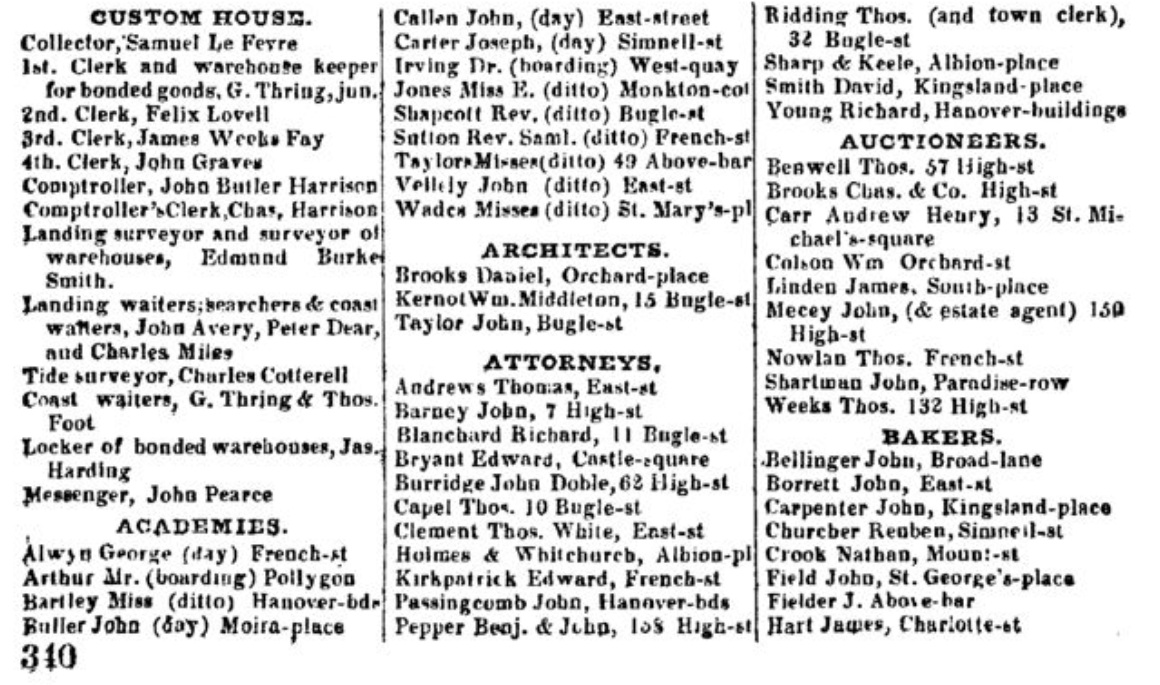
Transcript of Pigot's Directory of Hampshire, 1828, Southampton.
Southampton
A town and County of itself, is advantageonaly seated on the margin of the of the extensive bay called Southampton Water, formed by the union of the Testa, or Anton, and Itchen rivers, more than a mile in width opposite the town. It is a flourishing place, carrying on an extensive trade with the Isle of Jersey, Guernsey, and Newfoundland; as also with France and Portugal. It is also the principal packet station for Harvre de Grace, etc. which lends much to the influx and general prosperity of the town. Southampton is built on the extreme point of the high gravelly bank which separates the course of the Itchen river from the estuary of the Teste; by this happy choice the whole town, though almost surrounded by water, enjoys the advantage of the driest situation, and the fall of levels in every direction keeps the streets constantly free from damp and filth. It is a place of considerable antiquity, most probably arising out of the ruins of the Roman Clausentum at Bittern. There is very little doubt but that its name is derived from the river Anton, the Antona of Tacitus, which flows through the country, and joins the Teste at some distance before this river enters the Southampton water. The earliest mention of Southampton in history informs us, that in 873 it was ravaged by the Danes, who were repulsed. In the year 930 they again landed, and committed great destruction; and about 12 years afterwards visited the town a third time, plundering and destroying it with fire and sword. When Canute obtained the British sceptre, it appears that he made Southampton his occasional residence. It was at this place he so memorably rebuked the gross flattery of his courtiers. The principal entrance to the town on the land side is by the venerable remain of antiquity, the Bargate, the greater part of which is supposed to have been erected in the reign of Edward the III; in the central niche; two lions, cast in lead, guard the entrance; besides which there are two gigantic figures of Ascupart and his renowned conqueror, Sir Bevis, of Southampton. The walls with which the town was anciently encompassed are in many places quite destroyed, but in others they still present a venerable appearance. When Henry V. went on his expedition to claim the crown of France, he mustered his army at Southampton; during his abode in the town he discovered the conspiracy against him entered into by the Earl of Cambridge, Lord Scrope of Marsham, and Sir Thos. Grey, who were immediately arrested, tried, condemned, and executed. The were all buried in the chapel of God's-house. The beautiful castle, once the pride of Southampton, stood on the west side of the town. It was completed by the late Marquis of Landsdown, but is now entirely demolished. Its area was of a form approaching to a semi-circle or rather to a horse-shoe, of which the town wall to the sea formed the diameter. The keep stood on a very high artificial mount in the southern part of the area, from which there was a beautiful and highly interesting view of the town and adjacent country. There are six parishes and five churches in this town all of which are of considerable antiquity, except that of All Saints, which is a modern structure, having been erected since 1792, in the place of the former church, which was found to small for the parish, in consequence of the great increase of population. The front of this building, next the High-street, is ornamented with four three quater columns, of the Ionic order, four feet diameter and thirty-six feet high, supporting a pediment, on each side of which are the angles are finished with Grecian pilasters. The church, in the inside, including the vestibule, is 95 feet, its breadth 61 and its height, from the pavement to the middle of the ceiling (which is vaulted) is 47 feet. The building is almost wholly of brick stuccoed : a fine toned organ has lately been added to if, at an expence of upwards of £600. About 60 years since a lofty spire was added to the tower of St. Michael's church, for the purpose of being a sea mark to vessels entering this port. The other churches have nothing remarkable or worthy of particular notice. Southampton has numerous charitable foundations handsomely endowed, amongst which stands conspicuous the hospital called God's House, for a warden, four aged men, and as many women, who are allowed two shillings each weekly, and a donation of coals : this charity has, since its foundation had numerous benefactors. Divine service is performed in the chapel in the French language, for the accommodation of natives of the Islands of Jersey and Guernsey. There is also a range of alms-houses near the entrance of the town, erected a few years since, for the reception of eighteen poor widows, who are allowed two shillings each weekly from the produce of a bequest by Robert Thorner, Esq. who died July, 1690. Besides a good free grammar school, founded by Edward VI. there are several charitable foundations for the education of the infant poor. Southampton was originally constituted a borough by Henry I. King John granted to the burgesses many privileges. The present corporation, under a charter of Charles I. consists of a mayor, recorder, sheriff, two bailiffs, a common council, and town clerk. The first return to parliament was made in the reign of Edward the I. The mayor is admiral of the liberties from Southsea Castle, near Portsmouth, to Hurst Castle, near Lymington. The assizes of Oyer and Terminer and gaol delivery are held here once in 3 years. Of the several ports belonging to this county and the Isle of Wight, Southampton is the head or mother port. The custom house is convenient but not remarkable edifice, situated on the quay, at the west end of the town. This place is much frequented, in the bathing season, by persons visiting the sea coast for the restoration of health. A chalybeate spring, rising about two yards to the westward of Bargate, in great repute for its medicinal qualities, adds to the attractions which this place presents to invalids. The baths are convenient, and every attention is paid to the the accommodation and convenience of its numerous visitants. The assembly rooms, near the quay, are very elegantly fitted up; and a new theatre, of adequate dimensions, has been erected on the scite of St. John's hospital. Southampton races are annually held on Stoneham common, about three miles from the town. Here are four annual fairs, on the 17th. February, 25th. April, 6th. May, and 15th.December, for horses, cattle, and leather. The market days are Tuesday, Thursday, and Saturday. St. George's market has been lately erected, and is a neat building, peculiarly for butchers' meat, poultry, and vegetables. The population in 1811 was 9617 : and, according to the return made in 1821, amounted to 13.353, being an increase of nearly 4000 persons in ten years. Southampton abounds in elegant buildings, both public and private; and here we cannot omit noticing the chapel of the Independents, above the bar, which stands conspicuous for its magnitude, external neatness, and internal beauty. In the height of the season this place vies with and is not surpassed by the metropolis in the richness and splendour of its shops, the variety of equipages, and the numerous elegantly dressed pedestrians, which promenade the High-street and public walks; added to which, its cleanliness, the brilliancy of the gas, its gaiety, and great influx of strangers, all combine to render it the most agreeable and interesting town in the south of England.
End of transcript
Pigot's Directory of Hampshire, 1844, Southampton.

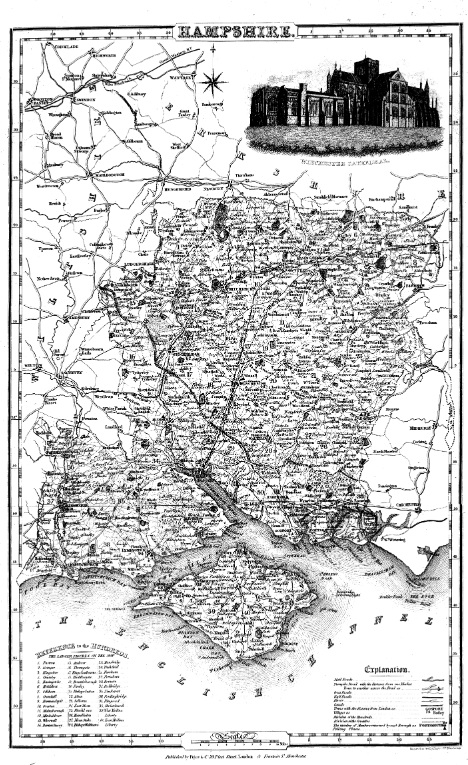
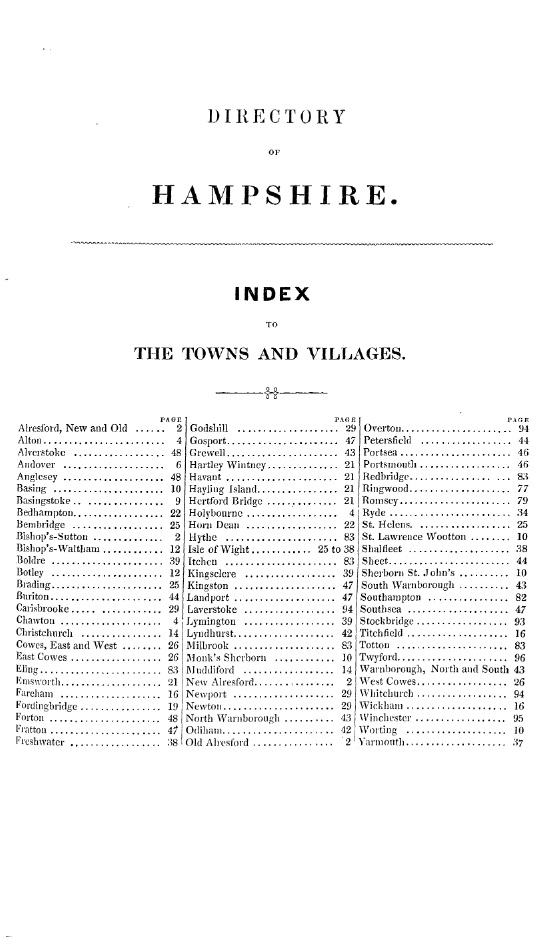
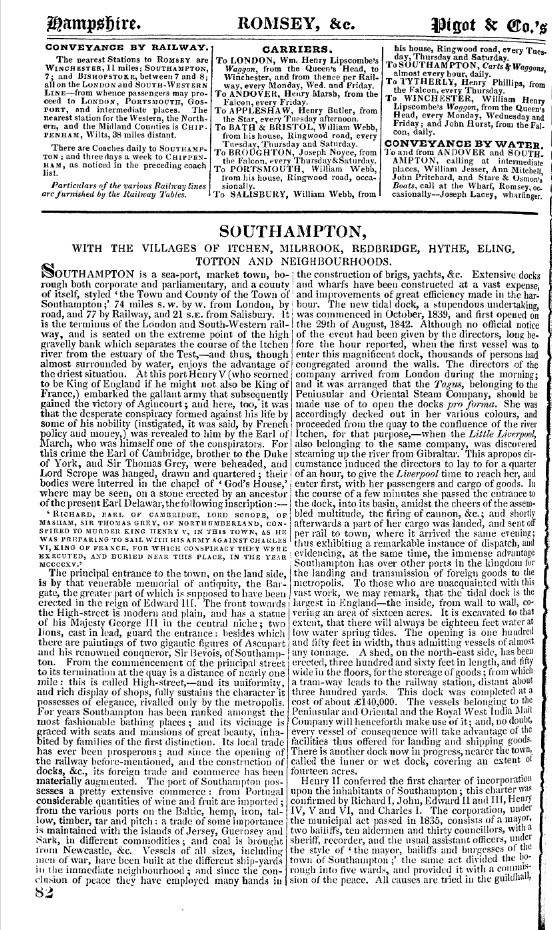
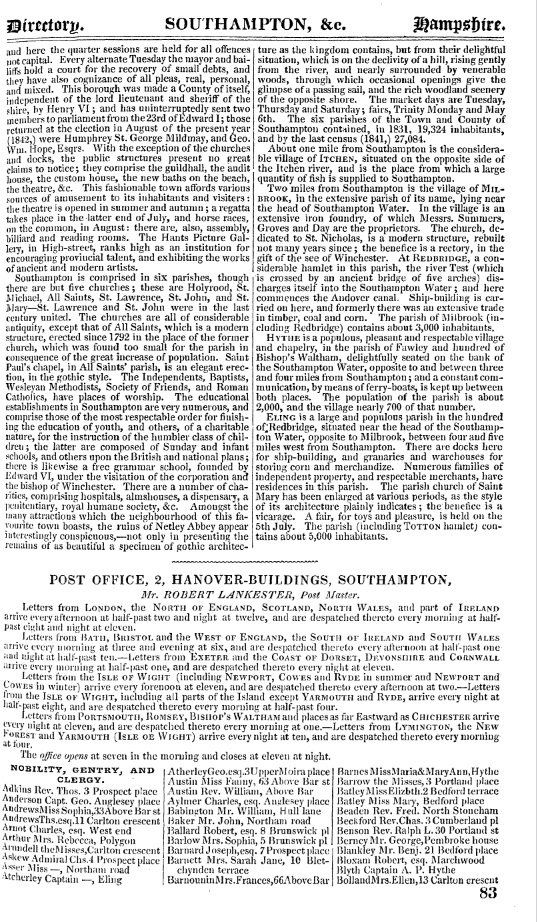
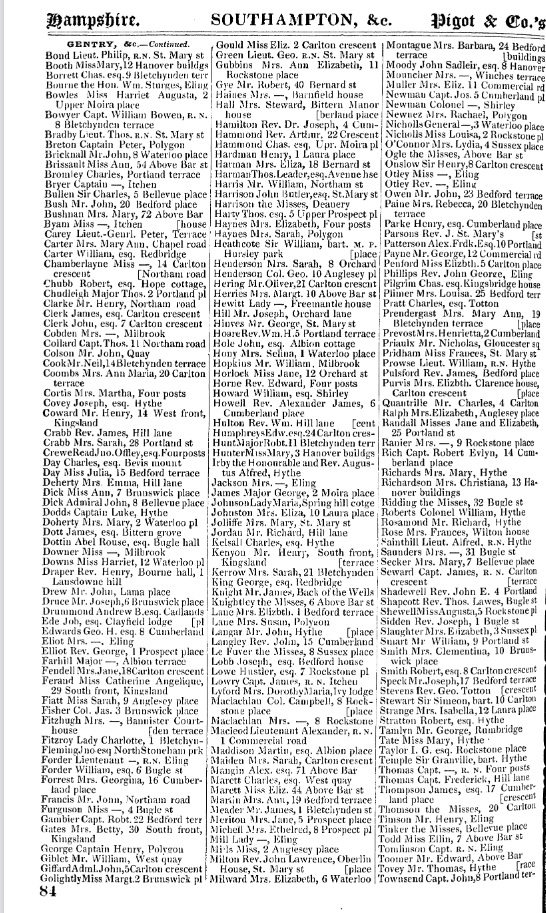
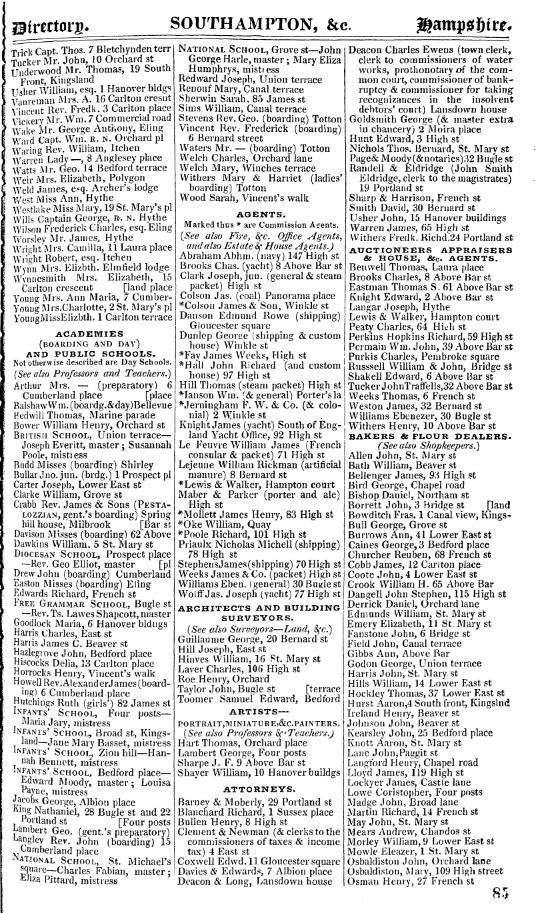
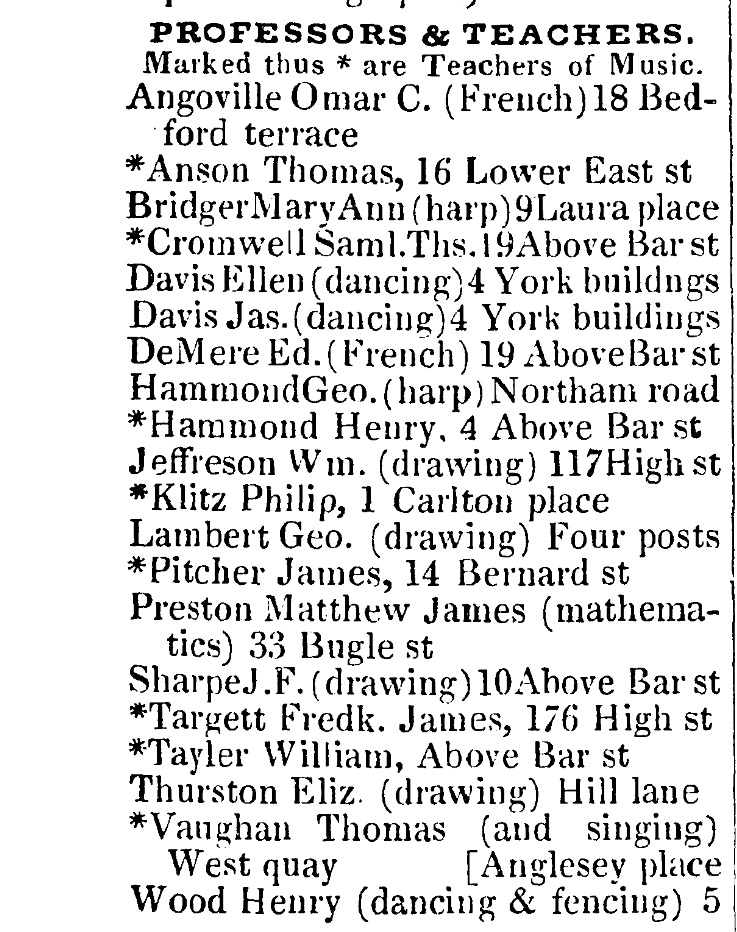
Even within this limited extract of Pigot's Directory of Hampshire, Southampton of 1828 and 1844, a meer16 years between publication dates, there is a very notable difference in the population of Southampton. Compare the lenght of the lists of Nobility, Gentry, and Clergy. Even the Academies list is much longer in 1844. Suggesting an explosion of wealth and population.
Despite the confirmation in the 1844 version, that nearby villages are included in the Southampton listing, very few of the Academies are in outlying villages.