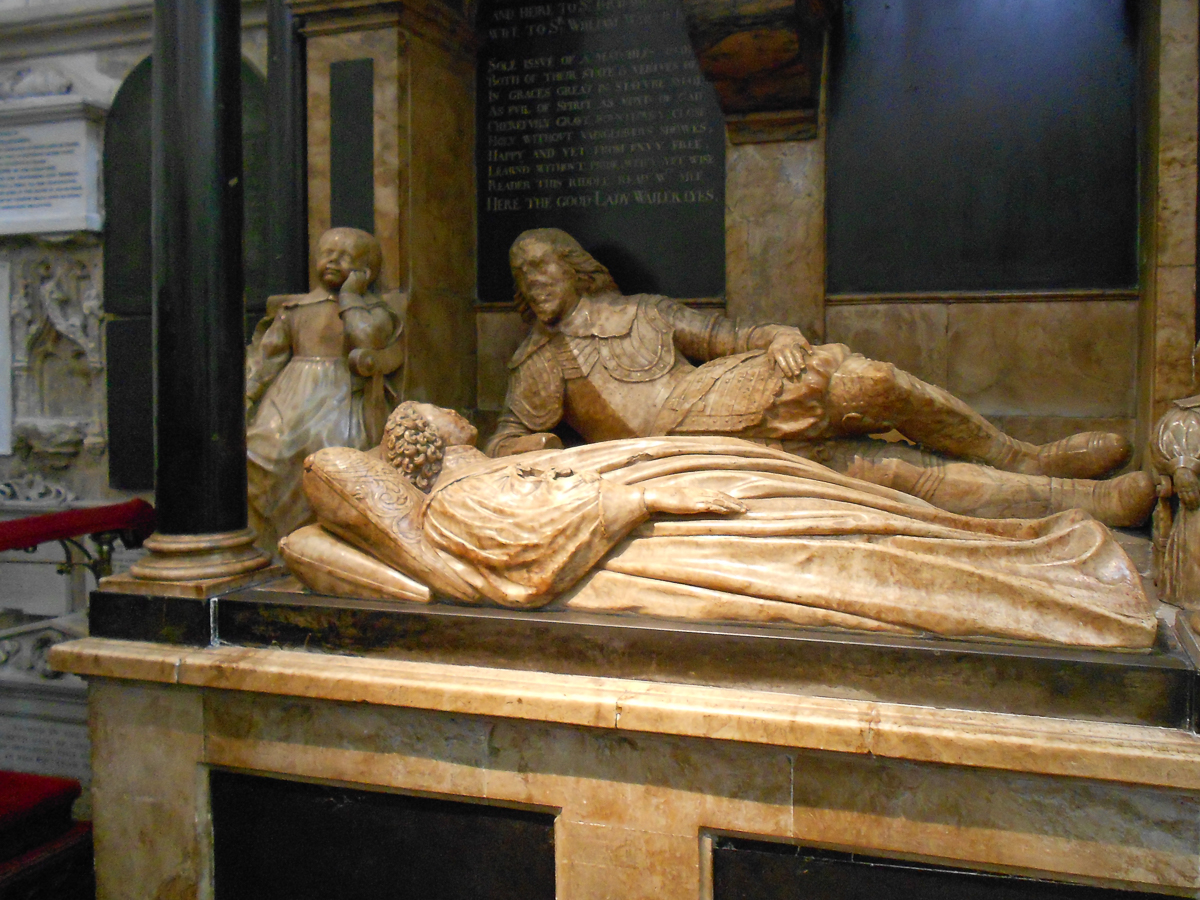



Sir Richard Sapcote of Elton in Huntingdonshire
Elton Hall was built by Sir Richard Sapcote (d. 1477), and was subsequently extended by his successors. This house was originally surrounded by a moat, now long since filled up, but in 1894 indications were found that it was 13 ft. deep. Robert Sapcote, who died on 4th January 1600/1 was probably the last of his family to live here, for in 1617 the property was finally sold coming into the possession of Sir Thomas Proby. In 1665, because of its ruinous condition, it was pulled down and a new house built in its place.
Thomas Semarc/Seymark [living 1451] left Anne Seymarc/Seymark, a minor, in ward to Sir Richard Sapcote [died 1477] of Elton in Huntingdonshire, Ann became the wife of William Sapcote [living 1483].
So, Sir Richard Sapcote was the guardian of Anne who married William Sapcote, which may look strange on a Family Tree.
Upton Huntingdonshire, Manors
... Thomas Lampert presented to the church in 1391. Possibly he died without male issue, as the manor seems to have passed to Ralph Basset of Sapcote, son of Simon Basset, son of Elizabeth, another sister of Edmund de Colville, who before 1395 granted the advowson and probably the manor to John de Eton and others, possibly feoffees. In 1442, John Fox conveyed the manor to John Lawrence, Richard Sapcote and John Collan, evidently on behalf of Richard Sapcote, who, as Richard Sapcote of Elton, presented to the church in 1443. By the middle of the 15th century all the manors and pourparties of manors in Upton and Coppingford had passed into the hands of Richard Sapcote. The manor of Upton descended with the Sapcotes of Elton until 1600, when Robert Sapcote died and left it to his grandson Edward Harington, son of his daughter Frances and James Harington.
Sir Richard Sapcote of Elton appears to be either in favour or fortunate as he seems to be amassing some wealth, property and influence.
Battle of Bosworth 22 August 1485
Parliamentary Record November 1845
DATE: November, 1485. AUTHOR: King and council. TEXT: "Rotuli Parliamentarium," ed. J. Strachey, 6 vols.(London, 1767-83), VI, p. 176. (English; spelling modernized.)
The act of attainder records that 'Richard, late duke of Gloucester, calling and naming himself, by ursurpation, King Richard the Third.' John late duke of Norfolk, Thomas earl of Surrey, Francis Viscount Lovell, Walter Devereux late Lord Ferrers, John Lord Zouche, Robert Harrington, Richard Charlton, Richard Radcliffe, William Berkeley of Weobley, Robert Brackenbury, Thomas Pilkington, Robert Middleton, James Harrington, knights, Walter Hopton, William Catesby, Roger Wake, William Sapcote, Humphrey Stafford, William Clerk of Wenlock, Geoffrey St German, Richard Watkins, Herald of Arms, Richard Revel of Derbyshire, Thomas Poulter junior of Kent, John Walsh alias Hastings, John Kendal, secretary, John Buck, Andrew Ratt, and William Bramton of Burford, on 21, in 'the first year of the reign of our sovereign lord, assembled to them at Leicester ... a great host, traitorously intending, imagining and conspiring the destruction of the king's royal person, our sovereign leige lord. And they, with the same host, with banners spread, mightily armed and defenced with all manner [of] arms, as guns, bows, arrows, spears, 'glaives', axes, and all other manner [of] articles apt or needful to give and cause mighty battle against our sovereign lord'. Keeping the host together, they led them on 22 August to a field in Leicestershire, and 'there by great and continued deliberation, traitorously levied war against our said sovereign lord and his true subjects there being in his service and assistance under a banner of our said sovereign lord, to the subversion of this realm, and common weal of the same.'
In English criminal law, attainder or attinctura was the metaphorical "stain" or "corruption of blood" which arose from being condemned for a serious capital crime. It entailed losing not only one's life, property and hereditary titles, but typically also the right to pass them on to one's heirs.
The word "attainder" is part of English common law. Under English law, a criminal condemned for a serious crime, whether treason or felony (but not misdemeanour, which referred to less serious crimes), could be declared "attainted", meaning that his civil rights were nullified: he could no longer own property or pass property to his family by will or testament. His property could consequently revert to the Crown or to the mesne lord. Any peerage titles would also revert to the Crown. The convicted person would normally be punished by judicial execution – when a person committed a capital crime and was put to death for it, the property left behind escheated to the Crown or lord rather than being inherited by family. Attainder functioned more or less as the revocation of the feudal chain of privilege and all rights and properties thus granted.
Sir William Sapcote at the Battle of Bosworth
Born in Elton, Huntingdon, England on 1429 to Richard Elton Sapcote and Alice VAUX. Sir Knight, William of Thornhough Sapcote, Battle of Bosworth married Lady Anne/Anna Semark and had 3 children. He passed away on 22 Aug 1485 in Huntingdon, Huntingdonshire, England.
The date that Sir William Sapcote passed away together with the act of attainder above suggest to me that he was on the losing side at the Battle of Bosworth and that was where he died. There is a Bosworth House in Huntingdon according to British History Online. Or the reference to Huntington above could be to the family seat in Elton, or to the Upton Manor. Elton is closest to Bosworth but it is still about 50 miles distant, which would take about 16hrs walking according to Google Maps