




The duchy of Normandy
The Duchy of Normandy arose out of a grant of land to the Viking leader Rollo by the French King Charles III in 911. In 924 and again in 933, Normandy was expanded by royal grant.
According to my Family Tree, Rollo of Normandy, 846-930, was my 9th great-grandfather of wife of husband of 3rd cousin 25x removed.
Rollo's male-line descendants continued to rule it until 1135. In 1202 the French king Philip II declared Normandy a forfeited fief and by 1204 his army had conquered it. It remained a French royal province thereafter, still called the Duchy of Normandy, but only occasionally granted to a duke of the royal house as an apanage.
However, looking at the list of French Kings, it is in my opinion, clear that Charles III, or Charles the Simple, was part of the Carolingian dynasty and was a King of the Franks, or King of West Frankia, which was yet to become France. The term King of France first appeared in the reign of Philip II Augustus (r. 1180–1223).
Counts and Dukes of Normandy
- Kings of England indicated by an asterisk (*)
Counts (911–996)
- Rollo, 911–927
- William I Longsword, 927–942
- Richard I the Fearless, 942–996
Dukes (996–1204)
- Richard II the Good, 996–1026
- Richard III, 1026–1027
- Robert I the Magnificent, 1027–1035
- William II of Normandy, later William the Conqueror* or William I of England in English-speaking countries, 1035–1087
- Robert II Curthose, 1087–1106
- William Rufus*, as regent 1096–1100
- Henry I Beauclerc*, 1106–1135
- William III Atheling (under his father, Henry I)
- William Clito, as claimant 1106–1128
- Stephen of Blois*, 1135–1144 (usurped from Matilda)
House of Plantagenet
- Geoffrey Plantagenet, 1144–1150
- Henry II*, 1150–1189
- Henry the Young King*, as junior duke 1170–1183
- Richard IV Lionheart*, 1189–1199
- John I Lackland*, 1199–1216, lost mainland Normandy in 1204.
- Henry III*, 1216–1259, renounced mainland Normandy and the ducal title by the Treaty of Paris (1259).
The family from Rollo of Normandy is extracted from Chronological tree of William I
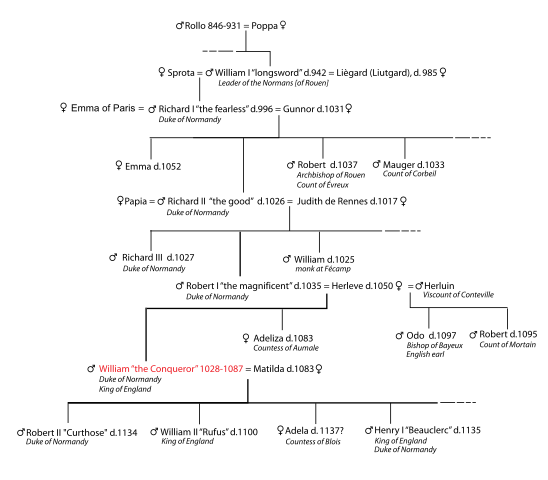 Family tree of the early dukes of Normandy and Norman kings of England <<> Public Domain, https://commons.wikimedia.org/w/index.php?curid=684495>
From the tree Richard II "the good" married Judith de Rennes. de Rennes is another branch of my Family Tree. I will have to explore this again to find the link to Judith. Possibly through Alain De Bretagne I, 860–907, King of Britany.
William "the Conqueror" Duke of Normandy, King of England
1028–1087 was my 4th cousin 6x removed of wife of husband of 3rd cousin 25x removed.
Matilda de Flanders.
Wife of William the Conqueror, who, incidentally, was previously known as William the Bastard.
Matilda was forbidden to marry Duke William of Normandy by the Council of Rheims in 1049.
Married him at Eu (now known as Eu, Seine-Maritime, Haute-Normandie, France) in 1053. Dispensation being granted by Nicolas II, 1059. Built Abbey at Caen as a penance.
In 1031, Matilda was born into the House of Flanders, the second daughter of Count Baldwin V of Flanders and Adela of France. Flanders was of strategic importance to England and most of Europe as a "stepping stone between England and the Continent" necessary for strategic trade and for keeping the Scandinavian Intruders from England.[2] In addition, her mother was the daughter of Robert II of France. For these reasons Matilda was of grander birth than William, who was illegitimate, and, according to some more romantic telling of the story, she initially refused his proposal on this account. Her descent from the Anglo-Saxon royal House of Wessex was also to become a useful card. Like many royal marriages of the period, it breached the rules of consanguinity, then at their most restrictive (to seven generations or degrees of relatedness); Matilda and William were third-cousins once removed. She was about 20 when they married in 1051/2; William was some four years older, and had been Duke of Normandy since he was about eight (in 1035).
The marriage appears to have been successful, and William is not recorded to have had any bastards. Matilda was about 35, and had already borne most of her children, when William embarked on the Norman conquest of England, sailing in his flagship Mora, which Matilda had given him. She governed the Duchy of Normandy in his absence, joining him in England only after more than a year, and subsequently returning to Normandy, where she spent most of the remainder of her life, while William was mostly in his new kingdom. She was about 52 when she died in Normandy in 1083.
Apart from governing Normandy and supporting her brother's interests in Flanders, Matilda took a close interest in the education of her children, who were unusually well educated for contemporary royalty. The boys were tutored by the Italian Lanfranc, who was made Archbishop of Canterbury in 1070, while the girls learned Latin in Sainte-Trinité Abbey in Caen, founded by William and Matilda as part of the papal dispensation allowing their marriage.