




The rise of the Franks
The Merovingian dynasty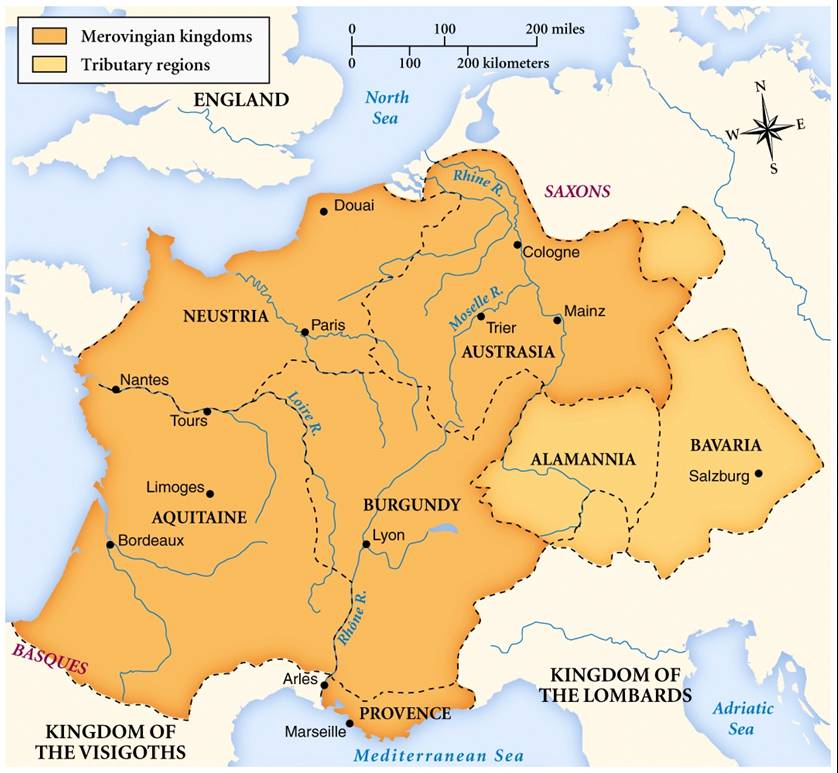 Merovingian dynasty -- By English wiki user Rudric, CC BY-SA 3.0, https://commons.wikimedia.org/w/index.php?curid=5748524 was the ruling family of the Franks from the middle of the 5th century until 751. They first appear as "Kings of the Franks" in the Roman army of northern Gaul. By 509 they had united all the Franks and northern Gaulish Romans under their rule. They conquered most of Gaul, defeating the Visigoths (507) and the Burgundians (534), and also extended their rule into Raetia (537). In Germania, the Alemanni, Bavarii and Saxons accepted their lordship. The Merovingian realm was the largest and most powerful of the states of western Europe following the breaking up of the empire of Theodoric the Great.
The dynastic name, medieval Latin Merovingi or Merohingii ("sons of Merovech"), derives from an unattested Frankish form, akin to the attested Old English Merewīowing, with the final -ing being a typical Germanic patronymic suffix. The name derives from King Merovech, whom many legends surround. Unlike the Anglo-Saxon royal genealogies, the Merovingians never claimed descent from a god, nor is there evidence that they were regarded as sacred.
The Merovingians' long hair distinguished them among the Franks, who commonly cut their hair short. Contemporaries sometimes referred to them as the "long-haired kings" (Latin reges criniti). A Merovingian whose hair was cut could not rule, and a rival could be removed from the succession by being tonsured and sent to a monastery. The Merovingians also used a distinct name stock. One of their names, Clovis, evolved into Louis and remained common among French royalty down to the 19th century.
The first known Merovingian king was Childeric I (died 481). His son Clovis I (died 511) converted to Christianity, united the Franks and conquered most of Gaul. The Merovingians treated their kingdom as single yet divisible. Clovis's four sons divided the kingdom between them and it remained divided—with the exception of four short periods (558–61, 613–23, 629–34, 673–75)—down to 679. After that it was only divided again once (717–18). The main divisions of the kingdom were Austrasia, Neustria, Burgundy and Aquitaine.
During the final century of Merovingian rule, the kings were increasingly pushed into a ceremonial role. Actual power was increasingly in the hands of the mayor of the palace, the highest-ranking official under the king. In 656, the mayor Grimoald I tried to place his son Childebert on the throne in Austrasia. Grimoald was arrested and executed, but his son ruled until 662, when the Merovingian dynasty was restored. When King Theuderic IV died in 737, the mayor Charles Martel continued to rule the kingdoms without a king until his death in 741. The dynasty was restored again in 743, but in 751 Charles's son, Pepin the Short, deposed the last king, Childeric III, and had himself crowned, inaugurating the Carolingian dynasty.
 The aforesaid Pepin II De Heristal, grandfather of Pepin the Short, was Mayor Of The Palace of Austrasia.
Under the Merovingian dynasty, the mayor of the palace (Latin: maior palatii) or (maior domus) was the manager of the household of the Frankish king.
During the second half of the seventh century, the office evolved into the "power behind the throne". At that time the mayor of the palace held and wielded the real and effective power to make decisions affecting the kingdom, while the kings were increasingly reduced to performing merely ceremonial functions, which made them little more than figureheads (rois fainéants, "do-nothing kings"). The office may be compared to that of the peshwa, shōgun, sarvadhikari or prime minister, all of which have similarly been the real powers behind some ceremonial monarchs.
In 687, after victory over the western kingdom of Neustria, the Austrasian mayor, Pippin of Herstal, took the title Duke of the Franks to signify his augmented rule. His son and successor, Charles Martel, ruled without elevating a new king during the last four years of his reign (737-741). His sons Carloman and Pepin the Younger (Pepin the Short) elevated another Merovingian king, Childeric III, but he was eventually deposed in 751 by Pepin, who was crowned king in his place.
Charles Martel, The Hammer, build on his father's legacy, conquered more lands, and ruled without a king for a while. The family completed the rise to power when Pepin the Short was crowned King of the Franks in 751.