


2021 - Society is broken, but is it more or less broken than in previous generations?
Firstly, why is this here, on my Genealogy / Family Tree web site?
Part of my interest stems from my school days. British Social Economic History 1750 to 1900 was, if memory serves, one of the text books. I also recall my Geography teacher trying to persuade me to take GCE Geography instead of the History that I had selected. He said he could guarantee that I would get a good Grade with Geography, adding that nobody passed History. I stuck with History and did pass. Several decades later, and I would like to think of a combined Geography and History course, as they are so intertwined.
My interest in Social Economic History and Migration continues into my Family Tree exploration. An understanding of the one helps interpret the other, in both directions. Measure people in their time and circumstance but learn from their history. History shaped today and today shapes our future.
Hopefully this is the introduction to a series of articles about society in 2021, how it is broken, considering several aspects. I have started with the current time and will go backwards, instead of perhaps the more normal approach of starting in the past and working towards today. Partly, to avoid running out of time and never finishing the work, but mainly to start with the more relevant, what is happening now.
To give that some context, I am a retired grumpy old man, with the mortgage paid off and a fixed income / pension, coming out of the latest Covid 19 Lockdown. During my career I have had roles including Change Manager and Business Improvement Manager, so do not find the thought of change unsettling or scary.
Some stories from my past.
I spent some time in Kenya in 1979 whilst driving through Africa. One of the things said at that time was about getting work done. "If you want something done, find a White man to do it, failing that an Asian, and if not a black man." Now I know that is hugely stereotypical and extremely racist. However, it was a widely held view, with a supposed justification of Asian's are hardworking and skilled, Black's are too inclined to manyana, Zulu and other languages for Tomorrow. In other words does not take timescales seriously. You could loose a level of management by leaving out the White man if you did not need the local connection or the somebody for the difficult task of navigating the the cultural maze of the cast system and finding the right Asian for a particular task. Was this mantra generated from racism or from experience. Obviously this is not acceptable today.
Attack at the market
Trip to The Bamiyan Buddhas
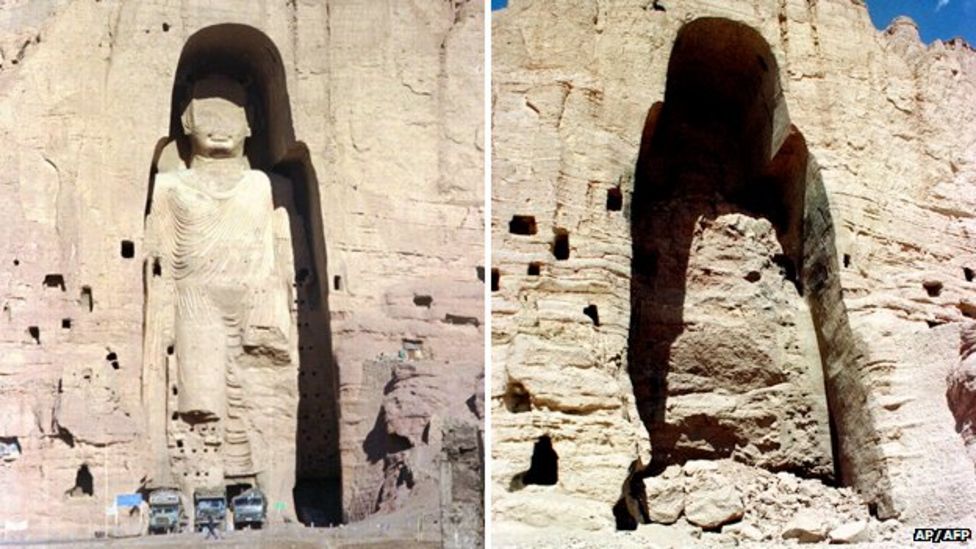
When I was travelling through Asia with my friend Pete in 1975, we set off from Kabul, the capital of Afghanistan, to visit the Bamiyan Buddhas. No internet available at the time so we found out about them by word of mouth. Several hours later we came to a fork in the road and had no idea if this was the way to the Bamiyan valley, or if it was a turning further along. If we kept going it was likely that we would not get back before dark. It is dangerous to drive at night, so without really knowing what we were missing out on, we turned around and returned to Kabul. No Sat Nav to help us, and only a rudimentary paper map. A big disappointment in hindsight. Now, I will never be able to see them, as you can see from the before and after, they were destroyed. Read about how and why in the BBC News article.
I recently watched a TV programme called 'Expedition Volcano, Part 2', and they visited a small village called Sake not far from Nyamulagira, a volcano which sometimes erupts twice a year. The team spoke to two Market traders. It was very insightful. "Here in Sake we've never had to flee the lava, but when the volcano does erupt it poisons the soil and destroys the crops. You can see the hot ashes in the air and when they cover the crops the crops die. There's nothing we can do, people die of hunger." "How often does that happen?" "Sometimes once a year, sometimes twice a year. Sometimes we get a break and there is no eruption for two or three years. Then it's good because it fertilises the soil and gives a good harvest." "We say the volcano has two faces. It kills but it also gives life. In this life we have to accept both pain and joy. When it is bad you have to be patient and when it's good you welcome it. We have to be patient, this is our home."
Amazingly pragmatic and hopeful, especially for people under the constant threat of disaster striking.